(Spoiler: your month-old marketing plan is currently crying in a corner)
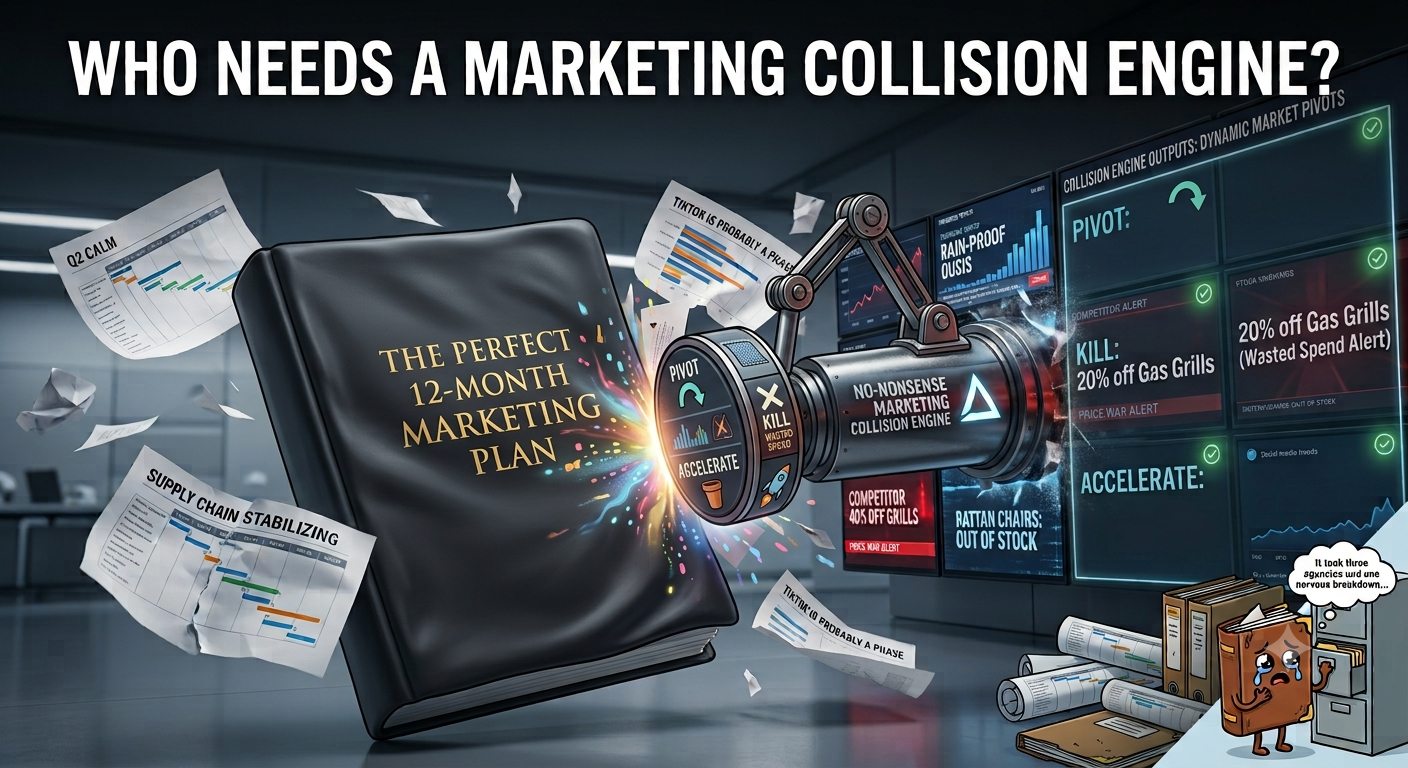
Somewhere in your organisation there is a document. It is beautiful. It has themes, budgets, target audiences and a colour-coded Gantt chart that took three agencies and one nervous breakdown to produce.
It is your 12-month marketing plan.
It was signed off in November — the same November in which you also believed Q2 would be calm, that the supply chain was “stabilising”, and that TikTok was probably a phase.
Since then, reality has been quietly filing objections. And here is the uncomfortable part: your plan has no inbox.
Watch what happens when the market moves and the plan doesn’t.
The campaign ships anyway. Not because anyone believes in it — but because the creative is already produced, the media is already booked, and someone presented it to the board with the word “flagship” in the title. Killing it now would require admitting something in public.
So it goes out. On schedule. Into a market that has moved on.
A Collision Engine exists for exactly this moment. It takes your static plan and continuously smashes it against two realities at once: the outside (what competitors just did, what your audience is actually reacting to, what the weather is doing to demand) and the inside (stock, margin, sold-out SKUs).
Where plan and reality disagree, you don’t get a 60-slide “gap analysis” three weeks later. You get a delta. Now.
Three commands. That’s the whole vocabulary.
1. PIVOT — right theme, wrong angle
Your plan says: launch the “Spring Balcony Oasis” campaign this week.
Reality says: your hero product — the rattan lounge chairs — is somewhere in a container near the Suez Canal, and it has rained on your core region for eleven consecutive days.
PIVOT: keep the budget, keep the slot, swap the hero. Waterproof outdoor rugs, high stock, better margin. Change the angle from “sunbathing” to “rain-proof your oasis.”
Same campaign. Different reality. Nobody has to apologise to the board.
2. KILL — the wasted spend alert
Your plan says: 20% off gas grills, full paid social blast, Thursday.
Reality says: the two big DIY chains went to 40% on similar grills yesterday. Your margin cannot follow them there, and your customers can use a search engine.
KILL: cancel the blast. Keep the €10k. You have no competitive advantage this week, and spending money to lose a price war more slowly is not a media strategy.
Yes, this is the alert nobody wants to receive. It is also the only one that pays for itself before lunch.
3. ACCELERATE — the white space
Your plan says: nothing. Week 24 is empty. It has always been empty. Week 24 is where marketing plans go to nap.
Reality says: “drought-resistant garden planning” is surging across social, your competitors are asleep, and there is half a million euros of terracotta and drip irrigation sitting in your warehouse doing absolutely nothing.
ACCELERATE: 48-hour campaign, generated from the trend and the stock position. Capture it before the trend becomes a trend report.
“But We Already Monitor the Market”
Of course you do. Let’s see how much of it.
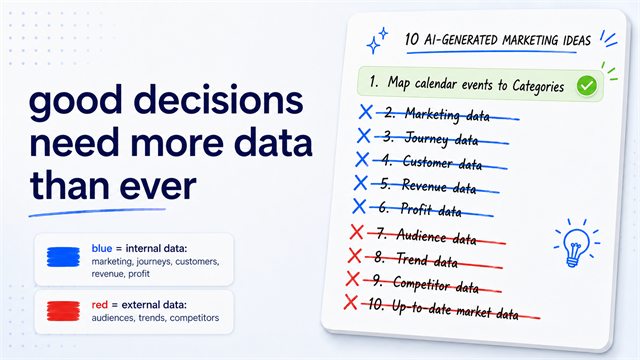
a) You look at the market from your own brand. Your channels, your engagement, your dashboard. That’s under 5% of the total audience view. You are not market-driven, you are mirror-driven. The mirror is very flattering and completely useless as a weather forecast.
b) You add 10–20 competitors. Congratulations: around 10%. This is the famous “competitive intelligence” slide — five logos, updated quarterly, maintained by an intern who left in March. You now know what your rivals said. You still have no idea whether anyone cared.
c) You add the audience response to your brand and those competitors. Now you’re at around 20%, and this is genuinely better — you’ve stopped counting what was published and started counting what landed. Most organisations never get here. The ones that do usually stop here, declare victory, and buy a bigger dashboard.
d) You monitor a thousand more brands — how their communication resonates, and what of it relates to your business. That’s roughly 80% of the total audience view.
Because your customer does not live inside your category. She does not compare your newsletter to your competitor’s newsletter.
She compares it to everything that hit her screen that morning — a fashion brand, a bank, a snack, a streaming service, a guy with a ring light.
Relevance is set out there, not in your category. Your category just has to pay for it.
The gap between (c) and (d) is where every “why did that campaign underperform?” post-mortem actually lives. You can’t debug it from inside your own 20%.
This is what outside-in means, and why the Collision Engine has anything to collide with. Feed a plan into 20% of the picture and you get opinions. Feed it into 80% and you get a delta.
And then the Part That Makes Finance Sit Up
Marketing’s favourite unit of measurement is the impression — largely because it’s the only one that can’t file a complaint.
The next step is less comfortable and much more valuable: closing the loop all the way to revenue and profit. Every activity maps to your order lines.
Which means every story theme links back to your category revenue.
“Caused” separated from “Correlated.” Uplift stated in € and margin, not in reach.
That’s a full issue of its own — it’s coming in one of the next newsletters, including the engineering traps that quietly destroy traditional attribution.
So: Who Needs a Marketing Collision Engine?
Nobody, really.
In precisely the way nobody needed brakes — right up until the cars got fast.
If your plan has survived contact with 2026 completely unchanged, you don’t need this. Genuinely. Frame the Gantt chart and hang it somewhere the light hits it.
For everyone else: book a free call with our experts.
Bring your actual plan of the next 4 weeks — the real one, not the sanitised board version. We'll run it against the market and show you the deltas.
Speak with an Expert → Subscribe on LinkedIn