For years, marketing teams had a production problem.
Creating enough campaigns, visuals, copy, variants and channel-specific content took time and money.
AI is rapidly removing that constraint.
And that creates a new one:
When everybody can produce more marketing, how do you know what is actually worth saying?
The bottleneck is shifting from content production to relevance selection.
Marketing and CRM teams don’t need another 100 campaign ideas.
They need help distinguishing marketing noise from actual audience need.
Your CRM may know 1 million customers. Your market contains 82 million people.
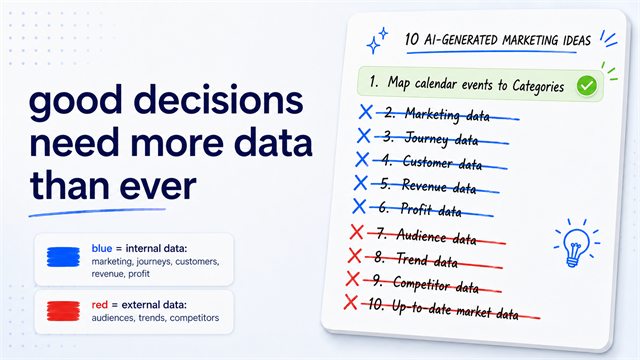
Most companies have become very good at looking inward.
CRM tells you what existing customers bought.
Web analytics tells you what visitors clicked.
Campaign reporting tells you what converted.
BI tells you what happened to revenue.
All valuable.
But there is a fundamental limitation:
Most of your future customers are not yet in your systems.
If you have one million customers in Germany, your internal view represents roughly one million people while your brand competes for relevance across a market of around 82 million.
And those 82 million do not wait for your campaign calendar.
Interests move. Seasons start early. Cultural moments appear. Competitors create momentum. New topics suddenly resonate. Others quietly stop working.
The market moves before the click.
That is the part traditional CRM and performance dashboards struggle to see.
The problem is becoming bigger, not smaller
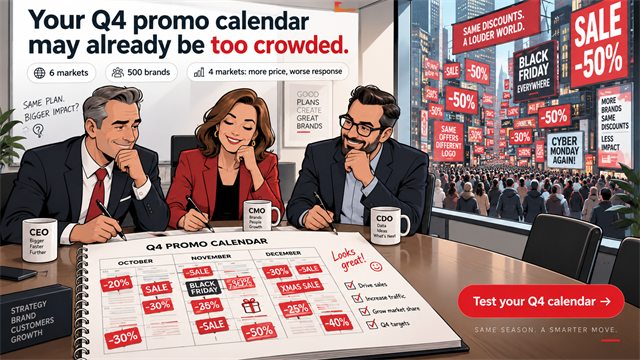
More AI-generated marketing means more messages competing for the same attention.
The logical response isn’t simply to produce even more.
It is to become better at answering:
What matters now?
That requires looking at three worlds simultaneously.
1 — The Wider Market
What are people responding to?
Look beyond your category.
What topics are gaining attention?
What motivations are emerging?
What is fading?
Which seasonal, cultural and behavioural windows are opening?
MarketWatch continuously observes approximately 2,000 consumer brands across the market to detect these movements.
2 — My Market
What is happening around my competitive position?
Your market is bigger than your competitor list.
It includes:
you + competitors + suppliers + partners + substitutes + surrogate brands
Why?
Because consumer expectations don’t respect industry classifications.
A fashion retailer can learn from beauty.
A home retailer from travel.
An insurer from automotive.
A premium brand from hospitality.
The relevant signal may originate somewhere you weren’t looking.
3 — My Business
Which of those opportunities actually matter to us?
Now bring the outside world together with what you already know:
customers, products, communication, sales, revenue, margin and other internal data.
This is where market intelligence becomes commercially useful.
The question is no longer:
What’s trending?
It becomes:
What’s changing outside — that matters specifically to our business?
A real example from this week’s market
The current MarketWatch B2C Commerce + Retail view shows why this distinction matters.
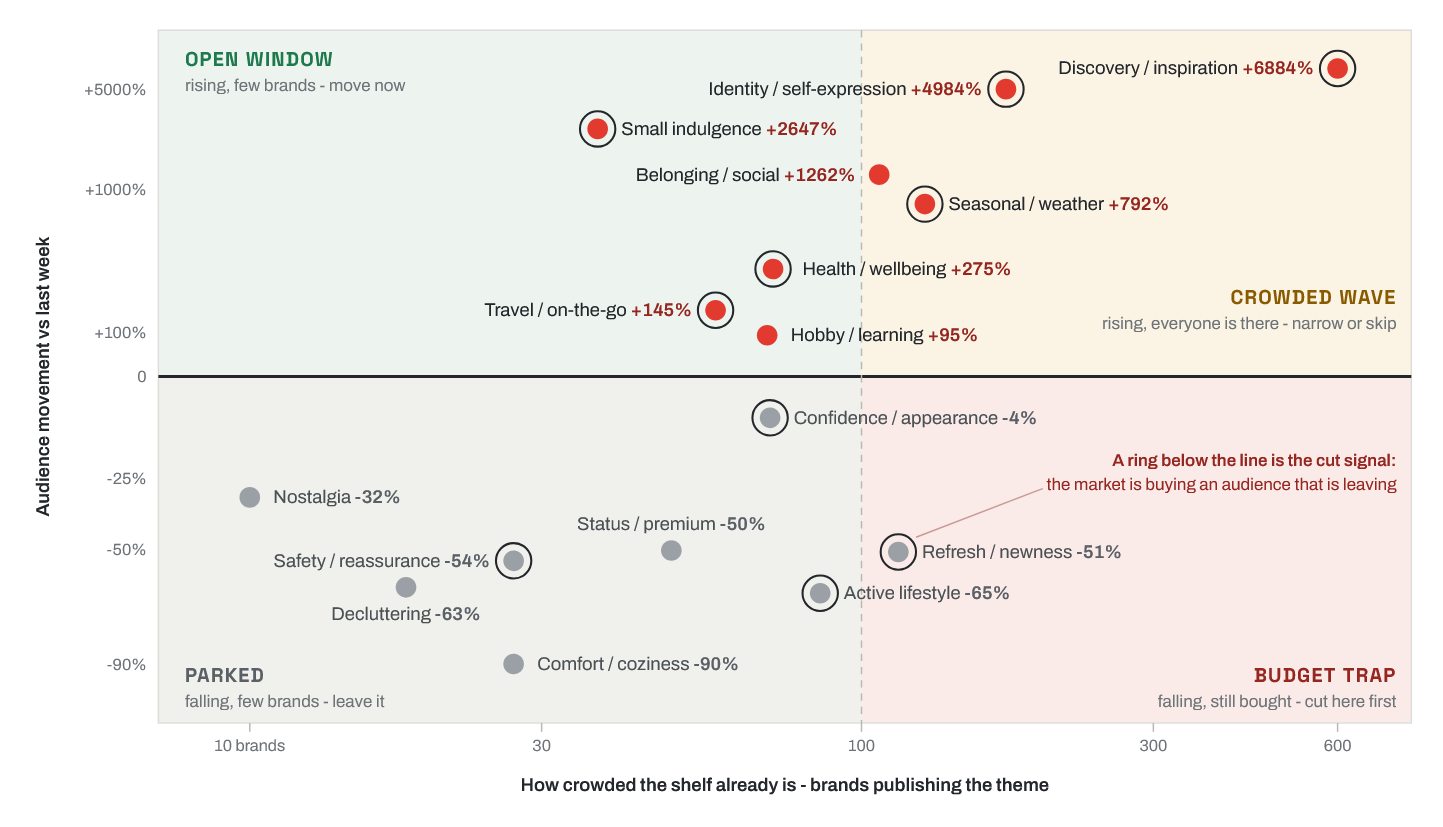
Audience attention is pulling strongly toward themes including identity/self-expression, travel and health/wellbeing.
At the same time, themes such as active lifestyle, home refresh/newness and comfort/coziness are cooling.
The interesting part isn’t simply that some themes rise and others fall.
MarketWatch also sees cases where advertisers continue buying attention in themes audiences are already leaving.
That is where marketing noise becomes expensive.
The current analysis therefore separates the market into:
- Open Window
- audiences rising, few brands there
- Crowded Wave
- audiences rising, but everybody has arrived
- Budget Trap
- audiences falling while advertisers still buy
- Parked
- little audience momentum and little market activity
That’s a very different question from:
“Which campaign had the best ROAS last week?”
It asks:
“Where is attention moving before everybody else follows?”
The competitive advantage is accumulated context
The long-term value of MarketWatch isn’t simply collecting more information.
And it isn’t another dashboard.
The advantage comes from continuously building a market memory:
what audiences responded to,
what competitors communicated,
which themes accelerated or faded,
how crowded an opportunity became,
what happened during the comparable period last year,
and how all of this relates to your own business.
A CEO or CMO doesn’t need another stream of signals.
They need the market reduced to the few changes worth paying attention to.
In an environment where producing marketing becomes almost unlimited, that ability becomes increasingly valuable.
The winners will not necessarily be the companies producing the most content.
They will be the companies that understand what deserves attention first.
See what the market is telling you this week
We have made this week’s B2C Commerce + Retail Wider Market analysis available as a free download.
It shows where audience attention is moving, where markets are becoming crowded, and where brands may still be buying into declining interest.
Download the current MarketWatch market summary →
novuter MarketWatch — see the market outside your radar.
Want this view for your own market?
Subscribe to the newsletter on LinkedIn, or talk to us about seeing where attention moves in your market, before everybody else follows.
Speak with an Expert → Subscribe on LinkedIn