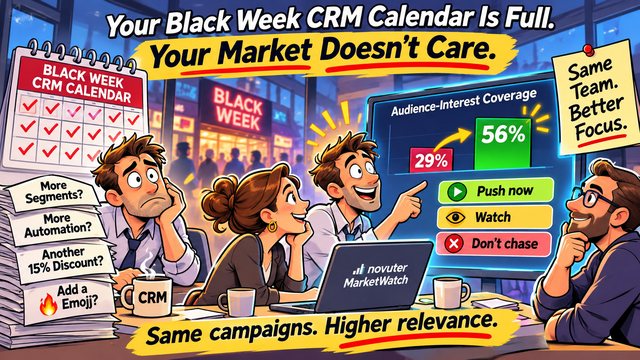
Every retail team has a Black Week dashboard. Most of them have one row: our own revenue, against our own last year.
Useful. Also possibly the least informative number in the building this week, because it can’t tell you whether the market moved, or you did.
So here’s the other dashboard: the market’s.
DACH retail, 9–14 November 2026, compared with the same week in 2025. We compare shares rather than volumes because our monitored brand universe has expanded.
Important: these figures describe entire retail segments. Individual brands may need very different actions. Comment or DM me for the scorecard specific to your brand.
1. The market scorecard: all retail
| Metric | 2026 | 2025 | Verdict |
|---|---|---|---|
| Black Friday activity (share of advertisers) | 7.2% | 7.5% | Almost identical timing |
| Christmas activity (share of advertisers) | 16.0% | 18.1% | 2.1 pts behind last year |
| Brands advertising 50%+ discounts | 11.3% | 12.6% | No overall escalation |
| Median advertised discount | 25% | 22% | Up 3 pts |
| Same 65 brands, median discount | 30% | 30% | Exactly the same depth |
| Price ads, share of all ads | 2.4% | 3.0% | Less price-focused |
| Black Friday ads without a numerical offer | 56% | 95% | The numbers arrive earlier |
The big jump from last year: in the following week of 2025, the Black Friday advertiser share went from 7.5% to 18.3%. That is the week when activity accelerated last year.
Three things matter
- Nobody is deeper, except Sports. The same 65 brands are discounting exactly as deeply as last year: 30%. Across retail, fewer brands are advertising 50%+ discounts. The much-discussed “discount war” is, so far, more rumour than reality.
- The numbers are arriving earlier. Last year, 95% of Black Friday ads in this period carried no numerical offer. This year, only 56% do. Black Friday is turning from a mood into an actual offer earlier than last year.
- The big jump is due now. Last year, Black Friday participation jumped from 7.5% to 18.3% in the following week. That following week is this week.
2. What is the audience rewarding?
Meta advertising response across all retail segments. Scores are normalised: 50 = typical advertising response, 80 = stronger than 80% of ads.
| Ad type | 2026 | 2025 | Change |
|---|---|---|---|
| Christmas / gift ads | 68.8 | 61.7 | +7.1 |
| Deep discounts (50%+) | 62.2 | 53.9 | +8.3 |
| Black Friday ads | 57.9 | 37.9 | +20.0 |
| Shallow discounts (below 50%) | 40.6 | 53.3 | −12.7 |
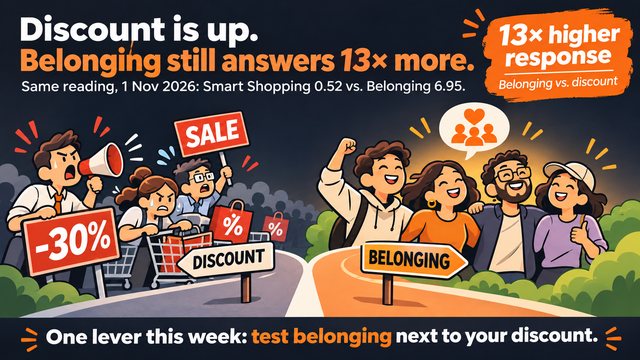
A gift ad scores 28.2 points higher than a shallow-discount ad. Last year, shallow discounts still performed around average. This year, they’re the weakest of these four advertising types, despite being the most common.
More discount advertising does not automatically mean more audience response.
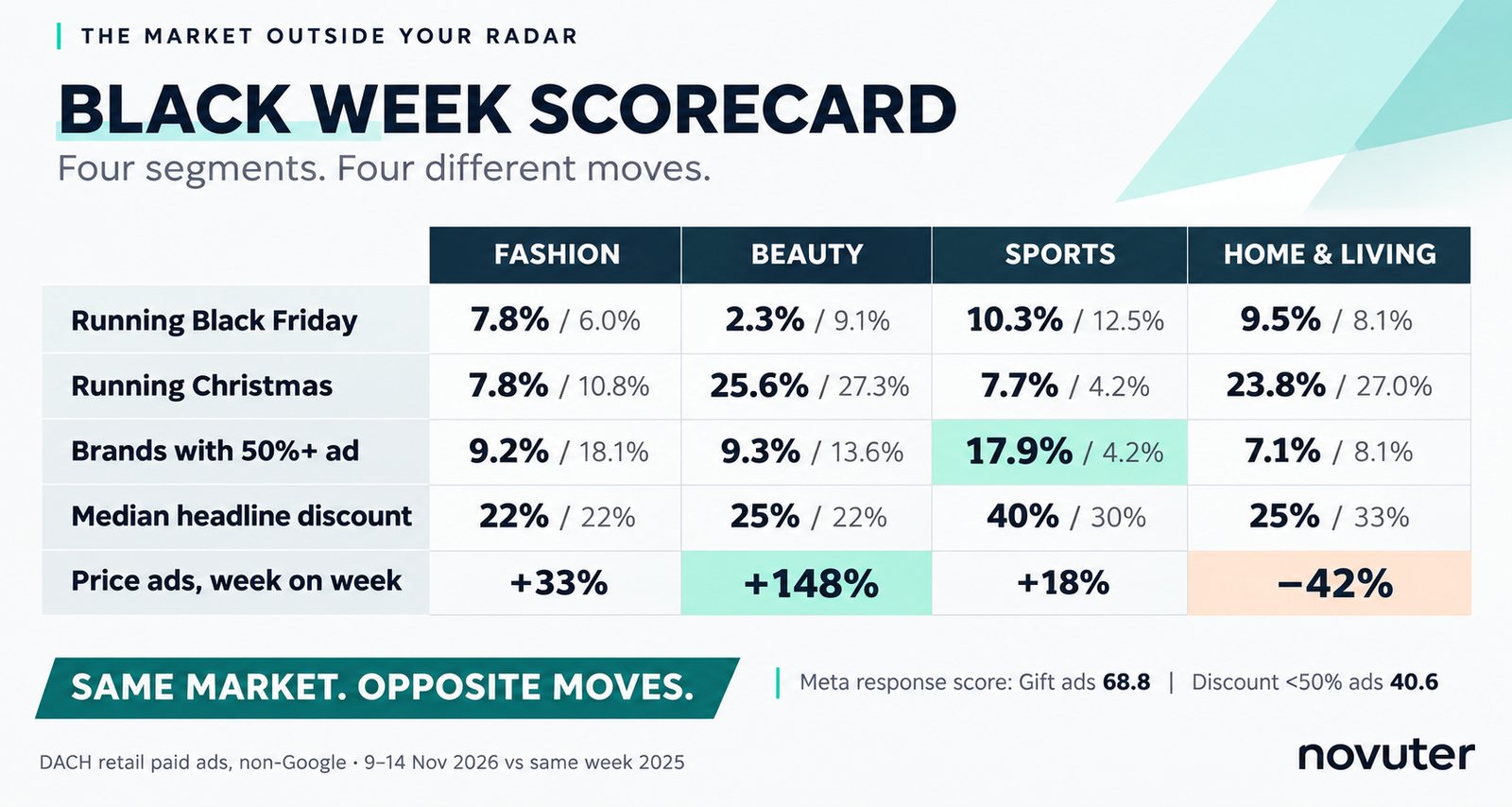
3. Four segments. Four different Black Week strategies.
All comparisons are 2026 versus the same week in 2025. Advertiser metrics show the share within each segment.
| Fashion | Beauty | Sports | Home & Living | |
|---|---|---|---|---|
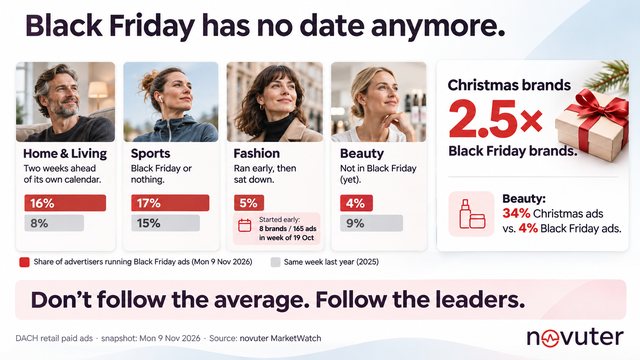
| Running Black Friday | 7.8% / 6.0% | 2.3% / 9.1% | 10.3% / 12.5% | 9.5% / 8.1% |
| Running Christmas | 7.8% / 10.8% | 25.6% / 27.3% | 7.7% / 4.2% | 23.8% / 27.0% |
| Brands with a 50%+ ad | 9.2% / 18.1% | 9.3% / 13.6% | 17.9% / 4.2% | 7.1% / 8.1% |
| Median discount | 22% / 22% | 25% / 22% | 40% / 30% | 25% / 33% |
| Price ads, week on week | +33% | +148% | +18% | −42% |
Fashion: more price ads, fewer deep discounts
Fashion is advertising more prices, but fewer deep discounts. Only half as many brands are advertising 50%+ offers as last year. Instead, more price activity is accumulating around the 20–30% range, precisely the discount range currently attracting the weakest response across retail.
Implication: more of the same is unlikely to create more attention.
Beauty: Christmas and giveaways, not Black Friday
Beauty is accelerating price advertising, almost 2.5 times the previous week’s level. Giveaway advertising jumped from 3 to 21 ads. More than one in four advertisers are already promoting Christmas. But only 1 of 43 advertisers is explicitly running Black Friday.
Implication: the real battle is for gifting attention, not the Black Friday label.
Sports: the discount war is real here
Sports is the exception. The share of brands offering 50%+ discounts has grown from 4% to almost 18%. Within one week, the number of brands advertising these deep discounts rose from 3 to 7. And the median discount is already 40%, compared with 30% last year.
Implication: if you’re competing on price in Sports, the competitive threshold has moved.
Home & Living: the pause before the next wave?
Home & Living has pulled back sharply. Price advertising is down 42% in one week. Median discounts have fallen from 33% to 25% year on year. Last year, the segment ran Black Friday promotions before Black Week and returned during Cyber Week. The current pause resembles that pattern.
Implication: watch for the next wave rather than assuming the market has gone quiet permanently.
4. Your Monday action plan
Four segments. Three decisions each.
| Push now | Watch | Don’t chase | |
|---|---|---|---|
| Fashion | Gift-focused creative. Gift ads score 68.8 across retail, while only 7.8% of Fashion advertisers run Christmas campaigns. | The deep-discount opportunity. The share of brands advertising 50%+ has nearly halved. | Generic Black Friday ads offering 20–30% off without a stronger reason to buy. |
| Beauty | Christmas sets, gift ideas and giveaways. | Price advertising is up 148% in one week. Is your competitive shelf getting cheaper? | A shallow discount with “Black Friday” added to the headline. |
| Sports | Identify which ranges can credibly compete with 50%+ offers. Seven competitors already advertise them. | The share of brands advertising deep discounts: 17.9% versus 4.2% last year. | A 40% market offer with an undifferentiated 30% promotion. |
| Home & Living | Christmas inspiration and gifting while competitors’ price advertising is quieter. | The potential return of stronger Black Friday and Cyber Week promotions. | Black Friday messaging without a concrete offer. |
5. The bigger lesson
Four segments. Same calendar. Completely different competitive realities. Sports is pushing deeper discounts. Fashion is advertising more prices without increasing discount depth. Beauty is shifting attention towards Christmas and giveaways. Home & Living is temporarily pulling back.
A single Black Week playbook cannot be right for all four. And a market average isn’t necessarily right for your brand.
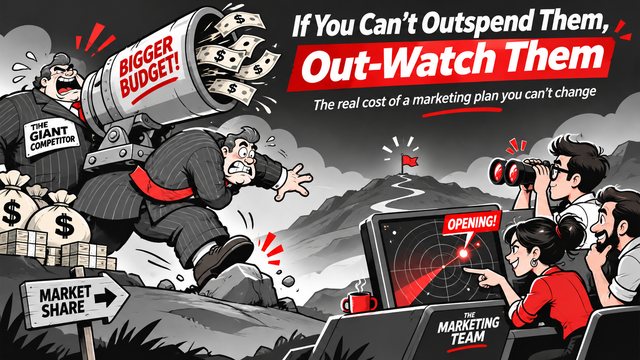
What matters is where your competitors are moving, what your relevant audience is responding to, and where the openings are emerging. Your annual marketing plan cannot predict all of that. But your next three to five days of marketing activity can respond to it.
Push now. Watch. Don’t chase. That’s what your Black Week dashboard should tell you every morning.
Book a 20-minute call at novuter.com. Bring your Black Week dashboard. We’ll add the market’s column.
Data: novuter MarketWatch, DACH retail paid ads (non-Google), 9–14 November 2026 versus the comparable week in 2025. Shares of each year’s advertisers; response scores from Meta ads, normalised to 50 = typical.
Bring your Black Week dashboard.
Book a 20-minute call. We'll add the market's column: what your competitors are moving, what your audience is answering, and where the openings are.
Speak with an Expert → Subscribe on LinkedIn