Every retail plan has the same line in it: “Black Week: 24–30 November.” It’s a lovely line. It’s also wrong for about half of you.
We counted the paid ads of DACH retailers in our market pool on Monday, 9 November. That’s one day, the first of the last two weeks before Black Friday. Here’s what “the market” looks like when you stop averaging it.
Two segments are already there
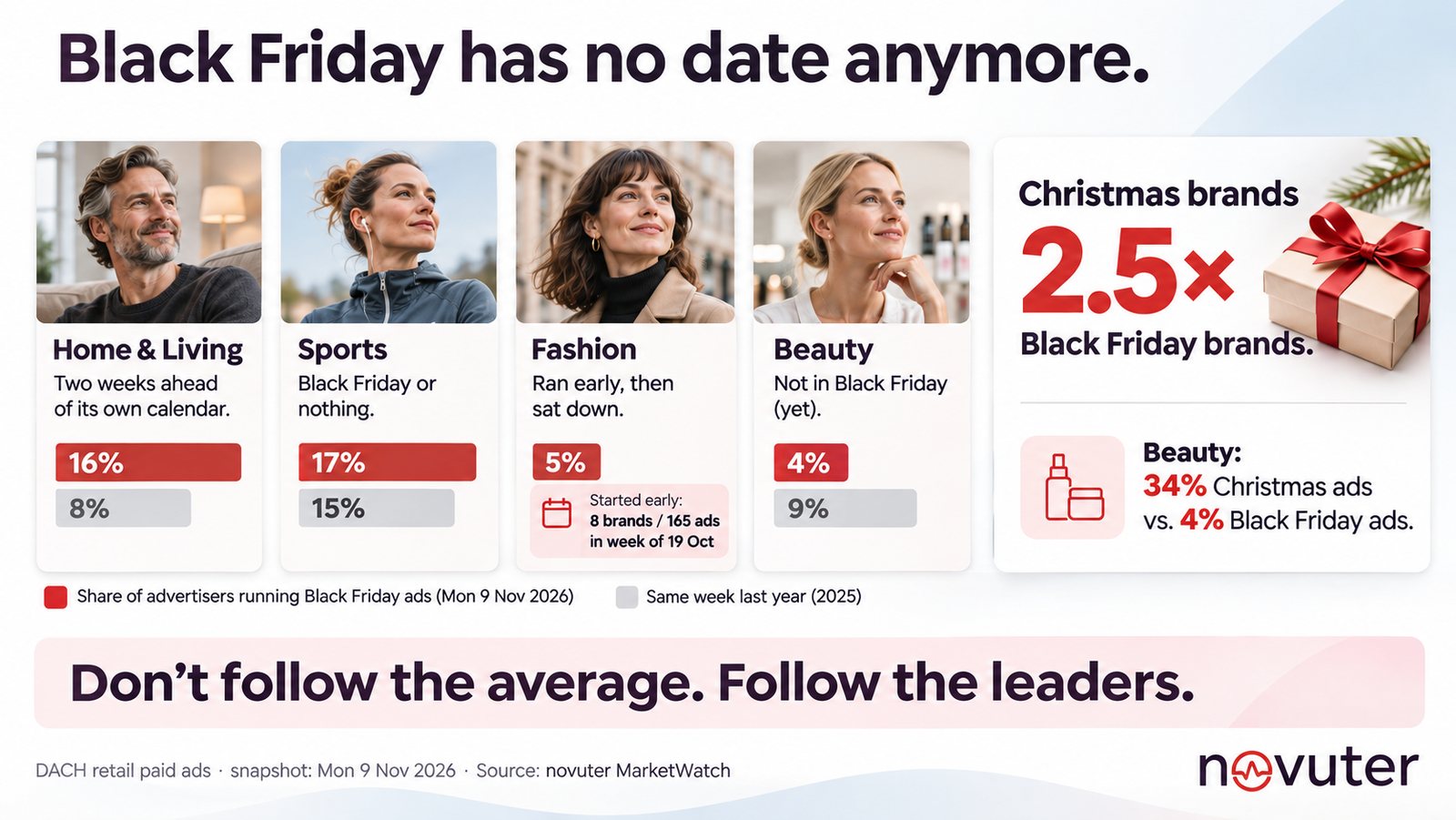
Share of each segment’s advertisers running Black Friday ads, on that one Monday:
| Segment | Mon 9 Nov 2026 | Same week 2025 |
|---|---|---|
| Home & Living | 16% | 8% |
| Sports | 17% | 15% |
| Fashion | 5% | 6% |
| Beauty | 4% | 9% |
Home & Living: 16%. Same week last year: 8%. Last year’s peak, in the week before Black Week, was 18%. Home & Living is two weeks ahead of its own calendar.
Sports: 17%. Same week last year: 15%. Headline discount: 60%, the same as last year’s Black Week. Sports doesn’t do Christmas: 3 of 36 brands run Christmas ads. It’s Black Friday or nothing.
One segment ran early and then sat down
Fashion: 5%. Same as last year’s track (6%). But Fashion started first: in the week of 19 October, 8 fashion brands ran 165 Black Friday ads (last year: 2 brands, 24 ads). Then it went quiet, and this week it’s busy with Singles Day.
One segment isn’t there at all
Beauty: 4%. Same week last year: 9%. In last year’s Black Week, 35% of Beauty advertisers ran Black Friday ads.
So the all-retail average reads “on schedule”. It hides one segment that’s two weeks early and another that’s behind. If your Monday slide says “the market”, it’s showing you nobody’s Black Friday.
Where Beauty went: Christmas
Here’s the part that isn’t about timing at all.
Last week, the share of advertisers running Christmas ads was identical to last year (16%). Then came Monday. On that one day, 21% of advertisers ran Christmas ads, more than in last year’s entire same week (19%).
On Monday, Christmas brands outnumbered Black Friday brands 2.5 to 1. In last year’s Black Week it was the other way round: 60 Black Friday brands, 43 Christmas.
Beauty is the cleanest case: 34% of Beauty advertisers run Christmas ads, 4% run Black Friday. Home & Living runs both, Black Friday at 16% and Christmas at 30%.
Black Week isn’t starting earlier. It’s being squeezed: Singles Day in front, Christmas in the same week.
A plan that gives week 48 to Black Friday and week 49 to Christmas is running on last year’s calendar.
So what do you do on Monday?
Two things, neither of which needs a new tool.
- Benchmark against your segment’s leaders, not the market. If you sell sofas, the question isn’t “is the market in Black Friday yet?” It’s “how many of the 43 Home & Living advertisers are, and since when?”
- Decide the Black Week / Christmas split now, not on 1 December. Your competitors already moved budget into gifting. The answer is yours, but make it a decision, not a calendar default.
Where it lands in your week
Monday 9:00, the Black Week stand-up or the weekly marketing meeting. One page in your inbox: your segment’s share in Black Friday and Christmas, last year’s curve beside it, and the three competitors who moved since last Monday. The CMO decides the split; the head of performance moves the budget the same day.
No new tool, no new process. An input into the one you already have. Your plan stays. Its coverage grows.
Book a 20-minute call at novuter.com. Bring your Black Week plan. We’ll put your segment’s live curve next to it.
Source: novuter MarketWatch, DACH retail paid ads (excluding Google), snapshot Monday 9 November 2026 vs 2025. Shares of each year’s advertisers; occasion classified from ad text.
Bring your Black Week plan.
Book a 20-minute call. We’ll put your segment’s live curve next to your plan: Black Friday and Christmas share, last year beside it, and the competitors who moved since last Monday.
Speak with an Expert → Subscribe on LinkedIn